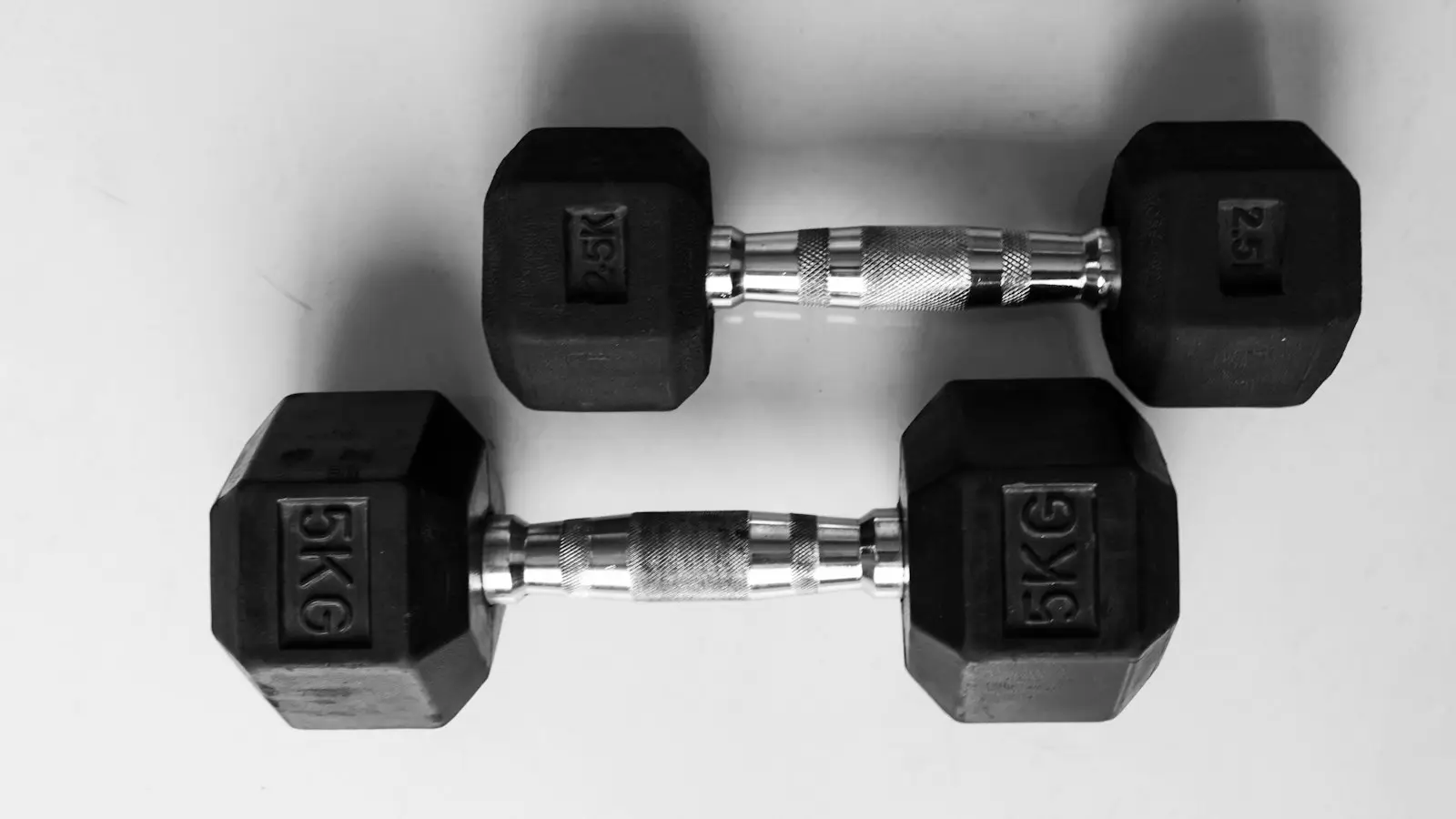
Say you've been lifting for three months. You step on the scale, and it hasn't moved. Frustrating, right? But your jeans fit better and your bench press keeps going up. What changed? Most likely your lean body mass. It's the part of your weight the scale can't see on its own, and once you understand it, your progress starts to make a lot more sense.
Let me explain what it is, how to estimate yours, and how to build more of it.
What is lean body mass?
Lean body mass (LBM) is everything in your body that isn't fat. Think of it this way:
Lean body mass = total weight minus fat mass
That "everything else" includes:
- Muscle
- Bone
- Organs, like your heart and liver
- Skin
- Water
You'll also see the term "fat-free mass." The two are often used as if they mean the same thing, and the formulas in this guide treat them that way.
Here's why it matters. Two people can weigh the same and have very different amounts of lean mass. A scale can't tell them apart. Lean body mass can.
Three ways to estimate your lean body mass
There's no easy way to weigh your muscles directly at home. So we estimate. Here are three common ways, from simplest to most personal.
1. From your body fat percentage
If you know your body fat, this is the most direct method:
LBM = weight × (1 minus body fat as a decimal)
Take a man who weighs 180 lb (81.6 kg) with 20% body fat:
180 × 0.80 = 144 lb (65.3 kg) of lean mass.
Don't know your body fat? Our body fat calculator estimates it with a tape measure.
2. The Boer formula (1984)
P. Boer published this formula in the American Journal of Physiology in 1984. It only needs height and weight (weight in kg, height in cm):
- Men: 0.407 × weight + 0.267 × height minus 19.2
- Women: 0.252 × weight + 0.473 × height minus 48.3
3. The Hume formula (1966)
R. Hume published this one in the Journal of Clinical Pathology in 1966. It also uses only height and weight:
- Men: 0.32810 × weight + 0.33929 × height minus 29.5336
- Women: 0.29569 × weight + 0.41813 × height minus 43.2933
Worked examples: how much do the formulas agree?
I ran two example people through all three methods. This is where it gets interesting.
Example A: a man, 5 ft 10 in (178 cm), 180 lb (81.6 kg), 20% body fat.
Example B: a woman, 5 ft 5 in (165 cm), 150 lb (68 kg), 30% body fat.
| Method | Example A (man) | Example B (woman) |
|---|---|---|
| From body fat % | 144 lb (65.3 kg) | 105 lb (47.6 kg) |
| Boer (1984) | 136 lb (61.5 kg) | 103 lb (46.9 kg) |
| Hume (1966) | 127 lb (57.6 kg) | 101 lb (45.9 kg) |
For the woman, the three methods land within about 4 lb (2 kg) of each other. For the man, they're 17 lb (8 kg) apart. Why? The Boer and Hume formulas don't know how much you train. They guess based on an average person of your height and weight. The body fat method uses your actual measurements, so it can pick up extra muscle.
What this means for you: if you lift, the body fat method is usually the more personal choice. Whatever you pick, stick with the same method so your numbers stay comparable over time.
Our lean body mass calculator does the math for you in a few seconds.
Why lean body mass is worth knowing
It sharpens your calorie estimate
Most calorie calculators use your total weight. The Katch-McArdle formula uses your lean mass instead:
BMR = 370 + (21.6 × lean body mass in kg)
BMR, or basal metabolic rate, is roughly the calories your body burns at rest. For Example A, that's 370 + (21.6 × 65.3) = about 1,780 calories a day.
For comparison, the Mifflin-St Jeor formula (Mifflin and colleagues, 1990) gives about 1,760 calories for the same man at age 35. The two are close here. Katch-McArdle can be more personal because it uses your lean mass, but it's only as good as your body fat estimate. You can check your own resting burn with our BMR calculator.
It lets you compare yourself fairly with FFMI
A 6 ft 4 in (193 cm) person will usually have more lean mass than someone who is 5 ft 6 in (168 cm). That doesn't mean they're more muscular for their size. Fat-free mass index (FFMI) fixes this:
FFMI = lean mass (kg) ÷ height (m) squared
A 1995 study by Kouri and colleagues in the Clinical Journal of Sport Medicine also used a "normalized" FFMI. It adds 6.3 × (1.80 minus your height in meters) to adjust toward a common height.
For Example A: 65.3 ÷ (1.778 × 1.778) = 20.7, or 20.8 normalized.
Here's the fascinating part. In that study, natural athletes who had never used steroids topped out at a normalized FFMI of about 25.0. Mr. America winners from before the steroid era averaged 25.4. So a score in the low 20s leaves a lot of room to grow. Check yours with our FFMI calculator.
How to build and keep lean body mass
Here's the good news. Lean mass responds well to two things you control.
1. Lift weights regularly. Strength training is the base. The protein research below was done in people doing resistance training, so the two work as a team.
2. Eat enough protein. A 2018 review by Robert Morton and colleagues in the British Journal of Sports Medicine found that gains in lean mass from strength training leveled off at about 1.6 g of protein per kg of body weight a day. The authors noted that up to 2.2 g/kg might help some people get the most out of training.
For Example A at 81.6 kg (180 lb), 1.6 g/kg works out to about 131 g of protein a day. Our protein calculator gives you a personal range.
When you're cutting
Losing fat without losing muscle is a common goal for gym-goers. The International Society of Sports Nutrition's 2017 position stand notes that higher protein intakes can help keep lean mass while you eat in a calorie deficit. So don't drop your protein when you drop calories.
If you have kidney disease, diabetes, or another health condition, talk to your doctor or a registered dietitian before you change your protein intake.
For more on training and eating for muscle, see our guide for gym-goers.
My take on lean body mass
Based on what I've seen in the research, lean body mass is one of the most useful numbers a lifter can track. It explains why the scale sometimes stalls while you're clearly getting stronger. It also keeps the focus on building something, not just losing something.
I wouldn't obsess over the exact figure, though. Every home method is an estimate, and as the examples show, the formulas can disagree by a lot. The real value is in the trend. If your lean mass holds steady or climbs over a few months while your body fat drops, you're doing it right.
The bottom line
Lean body mass is your weight minus your fat: muscle, bone, organs, and water. You can estimate it from your body fat percentage or with the Boer and Hume formulas. Track it the same way each time, pair it with FFMI for a height-fair view, and build it with steady strength training and about 1.6 g of protein per kg a day. Ready to see your number? Try our lean body mass calculator.