Most of us keep an eye on protein, calories, or sugar. Fiber tends to get left out. Here's a number that surprised me: the NHS says most UK adults eat about 20 g of fiber a day, while the target is 30 g.
So how much fiber per day do you actually need? The answer depends on your age, your sex, and how much you eat. The good news is that closing the gap is simpler than it sounds, and it doesn't take fancy foods.
Let me show you the targets, the foods that help most, and how to add fiber without upsetting your stomach.
How much fiber per day do you need?
In the US, fiber targets come from the Institute of Medicine (now part of the National Academies). Its 2005 report is also the basis for the US Dietary Guidelines. It uses a simple rule:
Eat 14 g of fiber for every 1,000 calories.
It also sets an "adequate intake," which is a daily amount that should cover most people's needs:
| Age | Men | Women |
|---|---|---|
| 19 to 50 | 38 g | 25 g |
| 51 and older | 30 g | 21 g |
The 14 g per 1,000 calories rule stays the same at every age. If you eat fewer calories, your number by calories goes down with it.
Targets in other countries
You'll see a few different numbers online. Here's where they come from:
- UK (NHS): 30 g a day for adults.
- World Health Organization: at least 25 g a day of naturally occurring fiber from food for everyone over age 10.
- CDC: 22 to 34 g a day for adults, depending on age and sex.
They're all in the same ballpark. For most adults, somewhere between 21 g and 38 g a day is the goal.
Your fiber target by calories
This part is actually really easy. Divide your daily calories by 1,000 and multiply by 14.
| Daily calories | Fiber target |
|---|---|
| 1,600 | 22 g |
| 2,000 | 28 g |
| 2,500 | 35 g |
| 3,000 | 42 g |
Here's a real example. When I ran a 60-year-old woman who weighs 150 lb (68 kg), is 5 ft 4 in (163 cm) tall, and is lightly active through the Mifflin-St Jeor equation, she came out at about 1,700 calories a day. At 14 g per 1,000 calories, that's about 24 g of fiber. Her adequate intake is 21 g. So a goal of 21 to 24 g makes sense for her.
Want your own number? Our fiber calculator does this math for you.
Why fiber matters
According to the CDC, fiber is a type of carbohydrate found mainly in fruits, vegetables, whole grains, and legumes (beans, peas, and lentils).
There are two main types:
- Soluble fiber dissolves in water and forms a gel in your stomach. This slows digestion. You'll find it in apples, bananas, oats, peas, and beans.
- Insoluble fiber doesn't dissolve. It moves through mostly whole. It's in whole wheat flour, bran, nuts, seeds, and the skins of fruits and vegetables.
Why should you care? The NHS says eating plenty of fiber is linked with a lower risk of heart disease, stroke, type 2 diabetes, and bowel cancer. Fiber also helps digestion and can help prevent constipation.
High-fiber foods to know
Here are common foods from USDA data, shown per 100 g (3.5 oz):
| Food | Fiber per 100 g (3.5 oz) |
|---|---|
| Chia seeds, dried | 34.4 g |
| Almonds | 12.5 g |
| Navy beans, cooked | 10.5 g |
| Oats, dry | 10.1 g |
| Black beans, cooked | 8.7 g |
| Lentils, cooked | 7.9 g |
| Chickpeas, cooked | 7.6 g |
| Avocado | 6.7 g |
| Raspberries | 6.5 g |
| Whole-wheat bread | 6.0 g |
| Green peas, cooked | 4.5 g |
| Broccoli, cooked | 3.3 g |
| Sweet potato, baked | 3.3 g |
| Pear | 3.1 g |
| Apple, with skin | 2.4 g |
| Brown rice, cooked | 1.6 g |
You'll usually eat much less than 100 g of chia seeds or almonds at once, so check the portion on the package.
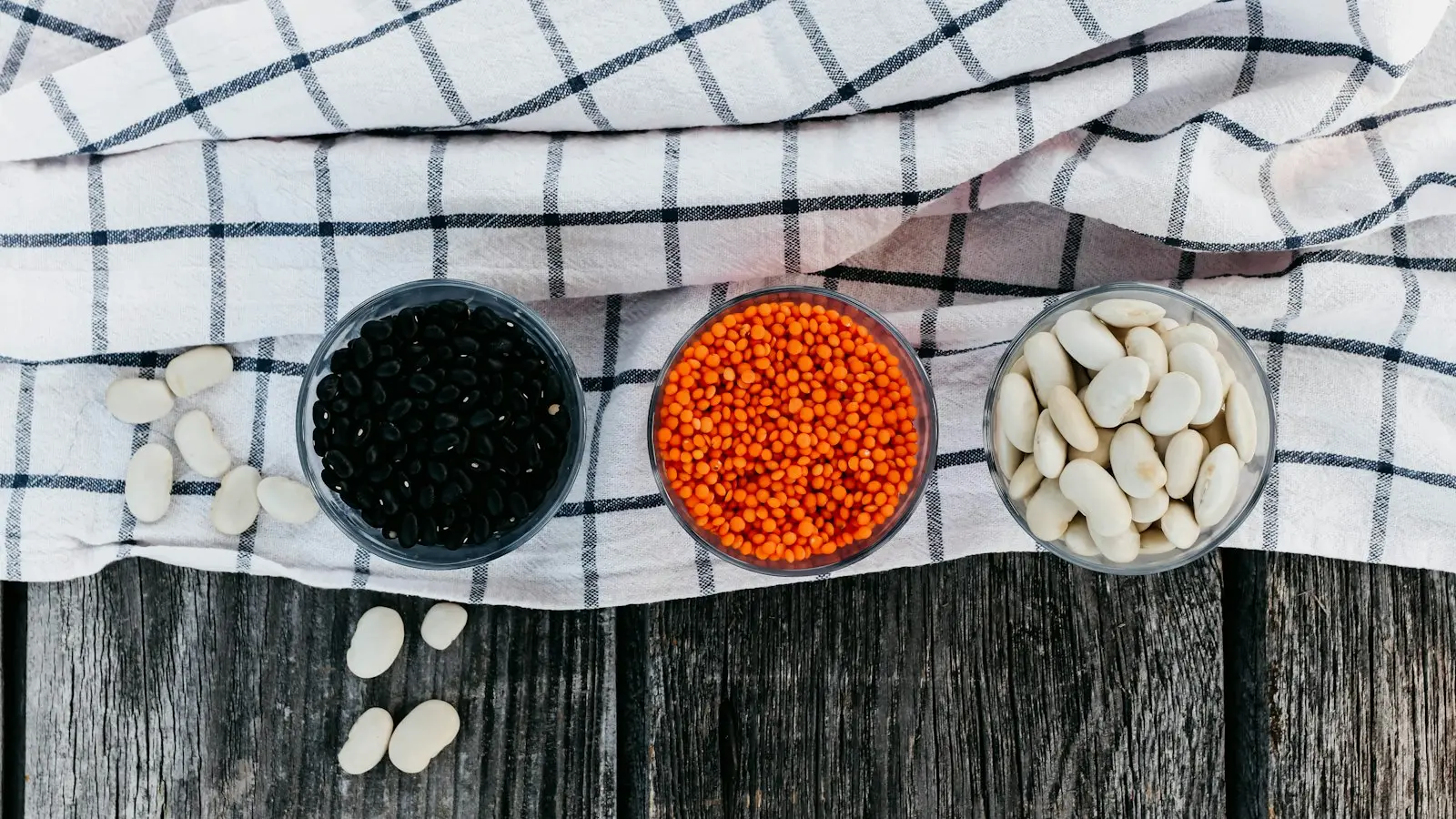
What stands out to me is beans and lentils. They give you fiber and protein together, which is a great combo if you're also chasing a protein goal.
Reading labels
The NHS offers a handy rule: a food is high in fiber if it has 6 g or more per 100 g. That's an easy check in the grocery aisle.
What a 30 g day can look like
The NHS gives sample meals that show how it adds up:
- Breakfast: 2 slices of wholemeal toast with peanut butter and a medium orange, about 8.3 g
- Lunch: wholemeal spaghetti with lentil and tomato sauce, about 11 g
- Dinner: grilled chicken breast, a skin-on baked potato, carrots, and green beans, about 11.2 g
That's about 30.5 g for the day. No supplements, no strange foods. Just regular meals with a few smart swaps.
Fiber when you eat out
Eating out doesn't have to mean a low-fiber day. A few picks from our restaurant guides:
- Chipotle: the High Protein-High Fiber Bowl has 14 g of fiber and 46 g of protein for 545 calories. See our Chipotle guide.
- Chick-fil-A: the Chicken Tortilla Soup has 17 g of fiber and 24 g of protein for 280 calories.
- itsu (UK): a side of Edamame has 17.4 g of fiber and 10 g of protein for 132 calories.
- Rola Wala (UK): the Red Dal Spice Bowl (Cauli) has 19 g of fiber and 18 g of protein for 338 calories.
Beans, lentils, and edamame show up again and again. That's no accident.
Fiber for specific groups
On a GLP-1 medicine
If you take a GLP-1 medicine like Ozempic, Wegovy, Zepbound, or Mounjaro, fiber gets a little more nuanced.
A 2025 joint advisory from four US nutrition and obesity groups says "adequate fluids and fiber from foods should be encouraged." It also notes that foods high in protein, fat, or fiber can slow stomach emptying further. For some people, that can make constipation worse and may mean limiting these foods for a while.
So there's no one-size answer here. Work with your doctor or a registered dietitian to find a fiber level that feels good for you. For more on eating well during treatment, see our guide to protein on Ozempic and our page for GLP-1 users.
Women
Women aged 19 to 50 have an adequate intake of 25 g a day, dropping to 21 g after 50. The NHS target of 30 g is a bit higher. Either way, most women can get there with fruit at breakfast, beans or lentils at lunch, and vegetables at dinner.
Adults 50 and older
Your fiber target goes down slightly after 50 (30 g for men, 21 g for women), but fiber still matters a lot. The Dietary Guidelines for Americans 2025 to 2030 note that some older adults need fewer calories but still need the same or more of key nutrients. That makes every bite count. Pairing fiber with protein, like beans with chicken or oats with Greek yogurt, covers two goals at once. Our guide to protein after 50 has more ideas.
How to add fiber without discomfort
Here's the one mistake to avoid: going from 15 g to 35 g overnight. The CDC warns that a sudden jump in fiber can lead to digestive discomfort.
Instead, try this:
- Add one high-fiber food a day. Swap white bread for whole-wheat, or add beans to a salad.
- Spread it out. The CDC suggests increasing fiber gradually across your meals.
- Drink enough water. The CDC says plenty of water helps food move through your system.
- Keep the skins on. The NHS suggests potatoes with skins, and fruit and vegetables where you can.
- Snack smart. The NHS lists fresh fruit, vegetable sticks, rye crackers, oatcakes, and unsalted nuts or seeds.
Give your body a week or two to adjust. Once you find a few go-to foods, it becomes second nature.
When to check with a professional
If you have a digestive condition, kidney disease, diabetes, or take medicines that affect your gut, talk to your doctor or a registered dietitian before making big changes to your fiber intake.
What this means for you
Based on what I've seen in the research, the biggest win isn't hitting an exact number. It's moving closer to it, step by step. If you eat 15 g now, getting to 22 g is real progress.
Start with foods you already like. Beans in your chili. Oats at breakfast. An apple with the skin on. Small swaps add up fast.
The bottom line
So, how much fiber per day do you need? For most adults, it's 14 g per 1,000 calories, which usually lands between 21 g and 38 g a day depending on your age and sex. The NHS rounds it to 30 g for UK adults.
You don't need supplements or special products to get there. Beans, lentils, whole grains, fruit, vegetables, nuts, and seeds will do the job. Get your personal target with our fiber calculator, then add one fiber-rich food at a time. You've got this.