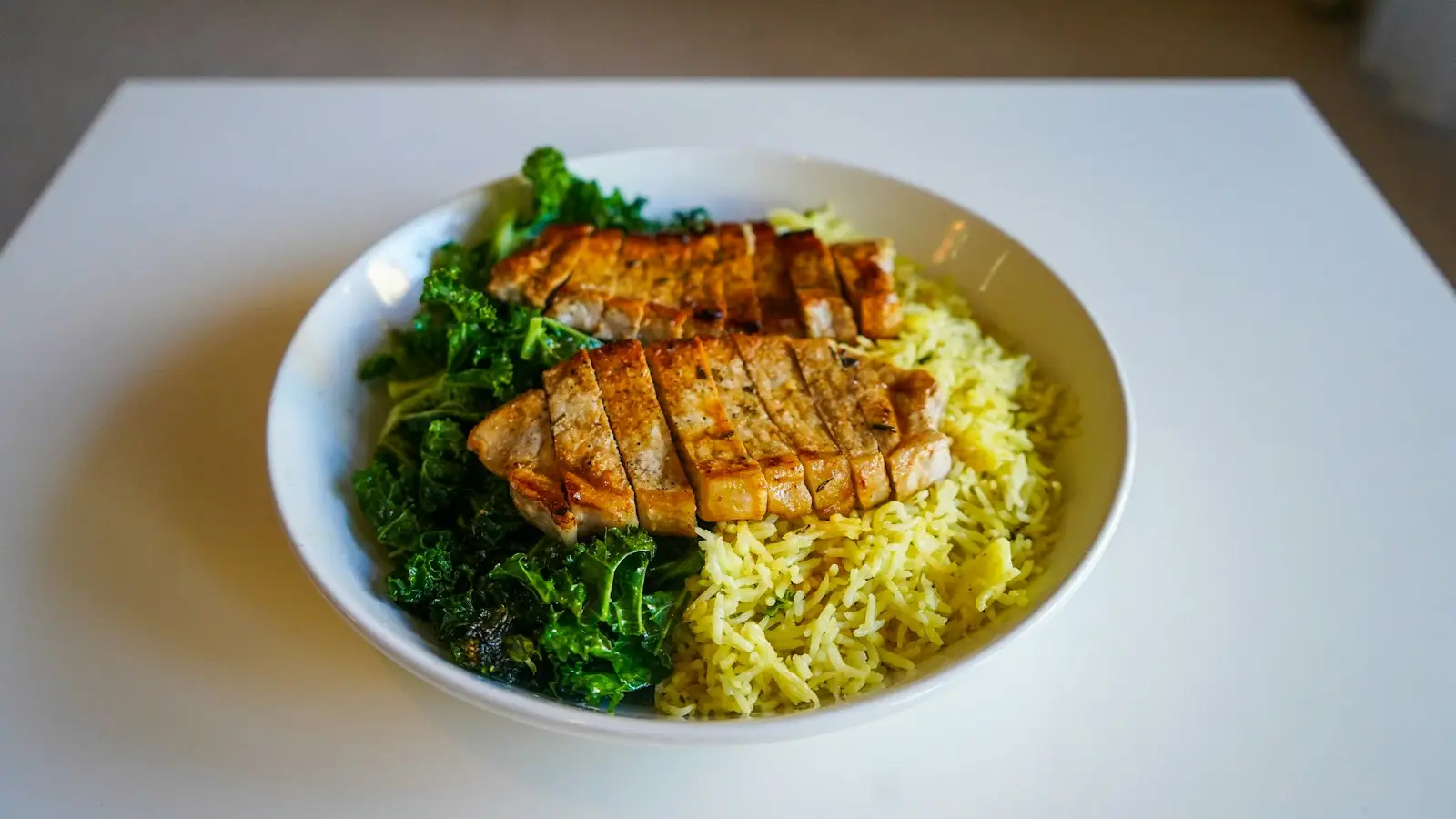
Picture a pretty common day. Coffee and toast for breakfast. A light sandwich at lunch. Then a big chicken dinner that carries almost all of the day's protein. The daily total might look fine on paper. But it raises a fair question: how much protein per meal should you actually aim for?
Here's the good news. You don't need a complicated plan. You need your daily number and a little division. Let me walk you through it, and then we'll look at what the research says about the size of each serving.
How much protein per meal? Start with your daily range
Every per-meal target begins with a daily one. On ProteinPlates, we base your daily range on your body weight and your goal. Here are the ranges our protein calculator uses, in grams of protein per kilogram of body weight per day:
| Goal | Daily range | Where it comes from |
|---|---|---|
| Maintain weight | 0.8 to 1.2 g/kg | 0.8 is the adult RDA (Institute of Medicine) |
| Build muscle | 1.6 to 2.2 g/kg | Morton 2018 meta-analysis |
| Lose fat | 1.6 to 2.2 g/kg | Morton 2018 and the ISSN position stand, to help keep muscle |
| On a GLP-1 medicine | 1.2 to 1.6 g/kg | 2025 joint advisory from four US groups |
| Healthy aging (50+) | 1.0 to 1.2 g/kg | PROT-AGE Study Group |
One detail worth knowing. If your BMI is over 30, the calculator uses the weight you would be at a BMI of 30 for your height. The 2025 GLP-1 advisory notes that using full body weight can overestimate protein needs in people with obesity.
Then the calculator does the simple part. It rounds your daily range to the nearest 5 g and splits it across 3 or 4 meals, whichever you choose.
Worked examples: gym-goers, adults 50+, and GLP-1 users
I ran three sample people through our protein calculator. These are illustrations, not personal advice.
A gym-goer building muscle: 180 lb (82 kg), age 28
- Daily range: 130 to 180 g
- Over 3 meals: about 43 to 60 g per meal
- Over 4 meals: about 33 to 45 g per meal
An adult over 50: 150 lb (68 kg) woman, age 66
- Daily range: 70 to 80 g
- Over 3 meals: about 23 to 27 g per meal
- Over 4 meals: about 18 to 20 g per meal
Someone on a GLP-1 medicine: 220 lb (100 kg) woman, 5 ft 6 in (168 cm)
Her BMI is about 35.5, so the calculator bases protein on about 186 lb (84 kg) instead of her full weight.
- Daily range: 100 to 135 g
- Over 3 meals: about 33 to 45 g per meal
- Over 4 meals: about 25 to 34 g per meal
Want your own numbers? Plug in your weight, height, and goal in our protein calculator. It takes under a minute.
What research says about protein per meal
Dividing by meals is practical. But is there a "best" amount per sitting? This is where it gets interesting.
Younger vs older adults
A 2015 analysis by Daniel Moore and colleagues in Canada, the UK, and the US looked back at their lab data on muscle protein building after a single protein dose. The response leveled off at about 0.24 g per kg of body weight in younger men and about 0.40 g/kg in older men (around age 71).
For a 150 lb (68 kg) person, that's about 16 g per meal when young, and about 27 g per meal when older. The authors concluded that older men are less sensitive to low protein intakes. The study only included men, so treat it as a rough guide for women.
Look back at the 66-year-old example above. Her 3-meal split of 23 to 27 g lines up well with that older-adult number. Her 4-meal split of 18 to 20 g falls a bit short. My take: if you're older and find it hard to eat a lot at once, 3 solid protein meals may be easier than 4 small ones. Our guide on protein after 50 goes deeper.
The gym-goer view
In a 2018 review, Brad Schoenfeld and Alan Aragon looked at how much protein the body can use in one meal for building muscle. Their conclusion: aim for about 0.4 g/kg per meal across at least 4 meals to reach at least 1.6 g/kg a day. At the upper end of 2.2 g/kg a day, that becomes about 0.55 g/kg per meal.
For our 180 lb (82 kg) lifter, that's about 33 to 45 g per meal. That is the same as the calculator's 4-meal split. Nice when the math agrees.
The "25 grams max" idea
You may have heard that your body can only use about 20 to 25 g of protein at once. Schoenfeld and Aragon note that this idea came from studies of fast-digesting protein eaten on its own. Newer research doesn't back it up as a hard limit.
A 2023 study by Jorn Trommelen and colleagues at Maastricht University compared 100 g and 25 g of protein after exercise. The 100 g dose led to a bigger and longer muscle-building response, lasting more than 12 hours. The researchers also reported that the larger dose had a negligible effect on how much protein was burned for energy.
So a big protein dinner isn't wasted. Still, spreading protein out makes the daily total easier to reach for most people.
What the experts still don't know
Here's an honest note. The PROT-AGE Study Group said in 2013 that the evidence on protein timing was not yet strong enough for specific recommendations. So treat per-meal targets as a helpful tool, not a strict rule. Your daily total is still the number the guidelines are built on.
What 25, 35, and 45 g of protein look like
Here are protein amounts for common foods, based on USDA FoodData Central.
| Food | Portion | Protein |
|---|---|---|
| Roast chicken breast | 4 oz (113 g) | 35 g |
| Baked salmon | 5 oz (142 g) | 31 g |
| Cottage cheese, 2% | 1 cup (226 g) | 24 g |
| Plain nonfat Greek yogurt | 1 cup (226 g) | 23 g |
| Canned tuna in water, drained | 4 oz (113 g) | 22 g |
| Firm tofu | 4 oz (113 g) | 20 g |
| Eggs | 3 large (150 g) | 19 g |
| Lentils, cooked | 1 cup (198 g) | 18 g |
| Paneer | 3.5 oz (100 g) | 16 g |
| 2% milk | 1 cup (8 fl oz, 237 mL) | 8 g |
A few easy combos:
- About 27 g: 3 eggs plus 2 slices of whole-wheat bread (64 g, about 8 g protein).
- About 35 g: 4 oz (113 g) chicken breast in a wrap or salad.
- About 45 g: 1 cup (226 g) Greek yogurt plus 4 oz (113 g) canned tuna across a meal. Or 5 oz (142 g) salmon plus 1 cup of lentils (49 g).
If 100 g a day feels hard, our guide on how to eat 100 g of protein a day breaks it down.
Hitting your per-meal protein when eating out
Chain menus make this easier than you might think. From the chain data on our site:
- Chipotle: High Protein Cup, Chicken (4 oz): 32 g protein, 180 calories.
- Chick-fil-A: 12 ct Grilled Nuggets: 38 g protein, 200 calories. The 8 ct has 25 g for 130 calories.
- Subway: Grilled Chicken Protein Bowl: 48 g protein, 620 calories.
- Starbucks: Iced Sugar-Free Vanilla Protein Latte (Grande): 29 g protein, 200 calories. Egg White & Roasted Red Pepper Egg Bites: 12 g protein.
For more ideas, see our top protein fast food picks.
Tips for GLP-1 users with a small appetite
If you're on a GLP-1 medicine, big meals may just not fit. The 2025 joint advisory offers a simple, useful tip: eat protein-rich foods first in a meal, so you're more likely to get enough before you feel full.
It also encourages protein from beans, peas, lentils, whole grains, dairy, seafood, eggs, and lean poultry. Choosing 4 smaller meals over 3 may help here too. Our guide on protein on Ozempic has more food-first ideas.
Check with your care team
If you have kidney disease, diabetes, or are pregnant, or you take any medicine, talk to your doctor or a registered dietitian about your protein target. PROT-AGE notes that people with severe kidney disease who are not on dialysis may need to limit protein.
The bottom line on how much protein per meal
So, how much protein per meal? Take your daily range and divide it by the meals you actually eat. In the three examples above, that ranged from about 18 to 60 g per meal. Older adults may do better with a bit more at each sitting, and gym-goers can aim for about 0.4 g/kg across 4 meals.
Don't stress about hitting a perfect number every time. Build each meal around a protein food, keep your daily total in range, and you're doing great. Get your personal per-meal numbers in our protein calculator.